The NHS Knee Queue Nobody Talks About — And the Window That Closes While You Wait
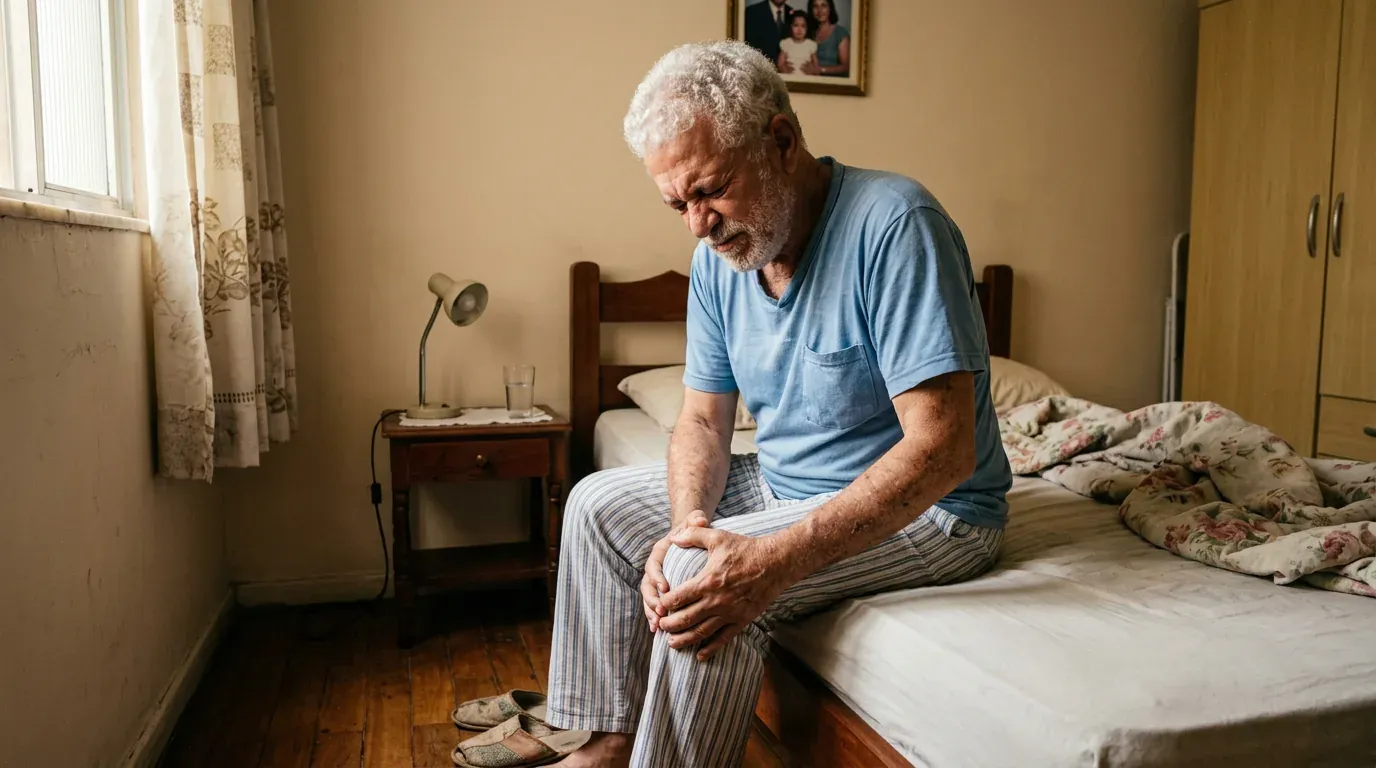
My father-in-law, David, is 68. Retired electrician. Lives in a semi in Nottingham with my mother-in-law, Pat. Keeps a vegetable patch going, walks the dog every morning, and wouldn't dream of making a fuss about his health.
That's the thing about men like David. They don't complain. They just… adapt.
First it was the stairs. He started gripping the banister with both hands — something I only noticed because our three-year-old tried to copy him. Then it was the garden. He stopped kneeling to weed and started using a long-handled fork, even though it took twice as long. Then one Sunday, he couldn't get up from his armchair without pushing off with both arms, and Pat caught my eye across the room.
When he finally went to see his GP — after months of Pat nagging — the consultation lasted eight minutes. Eight minutes to summarise thirty years of wear and tear on his knees.
Manage the pain. Get on the list. Wait.
That was the plan. And for millions of people in this country, it still is.
But what nobody told David — what nobody tells any of us — is that while you're waiting, something is happening inside your knee that can't be undone. And there's a specific point at which the damage crosses a line.
By the time I found out, David was nearly past it.
What "Managing the Pain" Actually Means
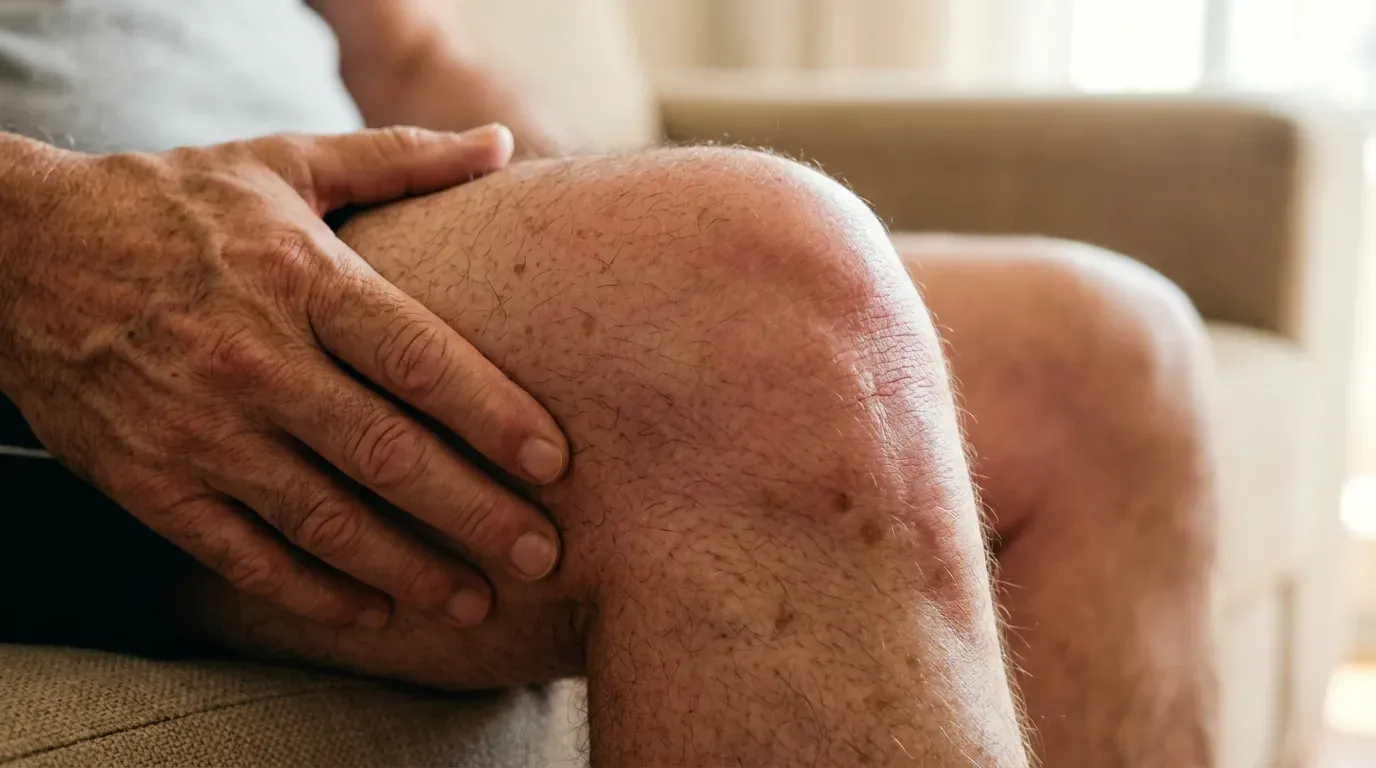
Osteoarthritis affects an estimated 5.4 million people in the UK — knees alone. If you're reading this, you almost certainly know the drill: the stiffness when you first get up, the ache after sitting too long, the sharp jab when you step off a kerb wrong.
And you probably know the routine that follows. Your GP prescribes one or more of the usual suspects:
Paracetamol — which studies now suggest does almost nothing for osteoarthritis pain. Ibuprofen — which works for a few hours but puts your stomach and cardiovascular system under strain, especially over months and years. Codeine-based painkillers — which the NHS itself warns can lead to dependency. Steroid injections — which offer temporary relief but may actually accelerate cartilage breakdown after repeated use. Gel patches and rubs — which numb the surface but don't reach the joint capsule.
Here's what links every single one of those treatments: none of them addresses what's actually happening inside your knee.
They suppress the signal — the pain — while the process carries on underneath. And that process doesn't pause because you've taken a co-codamol. It doesn't slow down because you've rubbed Voltarol on your kneecap.
While the pain is being masked, the clock keeps ticking.
The 5 Stages of Knee Deterioration That Your GP Doesn't Have Time to Explain
In my nine years of reporting on joint health, I've spoken to dozens of orthopaedic specialists, physiotherapists, and pain consultants. What none of them would disagree with — but none of them have time to explain in an eight-minute appointment — is that osteoarthritis of the knee follows a pattern. A progression. And within that progression, there is a window.
Not a wide window. Not an obvious one. But a real one.
I've come to think of it as five stages — not the clinical Kellgren-Lawrence grades your consultant might use, but the stages as you experience them, in your daily life, right now.
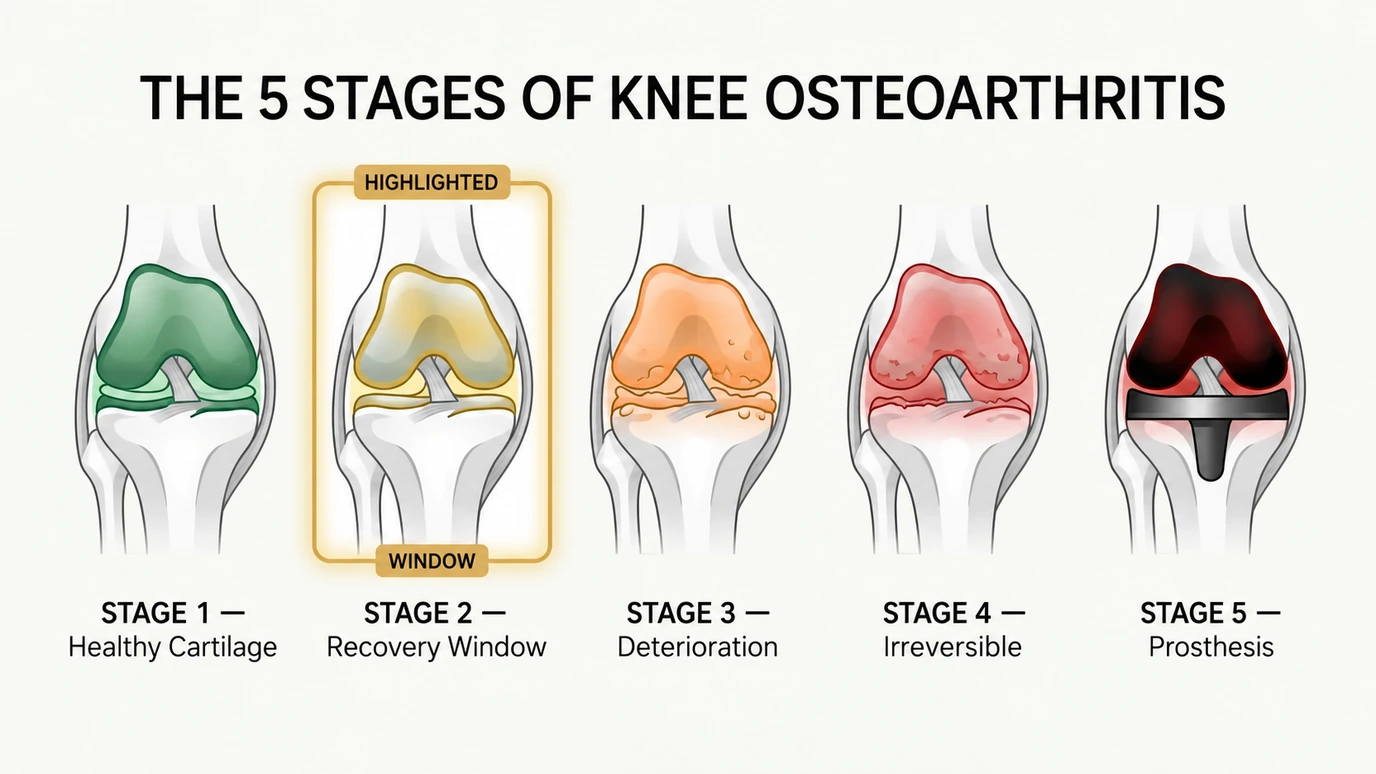
Stage 1 — The Niggles
The occasional click or pop when you bend your knee. Mild stiffness first thing in the morning that loosens up after a few minutes. A vague awareness that one knee doesn't feel quite right. You dismiss it. Everyone does. "I'm just getting older."
Stage 2 — The Quiet Decline
This is where most people reading this will recognise themselves.
The stiffness in the morning lasts longer — fifteen, twenty, thirty minutes before you can move properly. Stairs have become a calculation: which leg goes first, how fast, whether you need the rail. You've noticed that sitting in the car or at the dining table for more than half an hour makes getting up a slow, cautious process. There's a dull ache that follows you through the day, not agonising, but constant — like a headache you can't shake. You've probably cut your walks shorter without admitting it. The dog still goes out, but you've swapped the long loop through the park for a quick turn round the block.
If you're reading this and nodding, this is almost certainly where you are.
And this is the stage that matters. Because Stage 2 doesn't feel urgent. The pain is real, but it's bearable. You can cope. You tell yourself there are people worse off. You'll sort it out eventually.
That's exactly what makes Stage 2 so dangerous.
Stage 3 — The Tipping Point
The pain is no longer just on movement — it wakes you at night. The swelling doesn't go down as it used to. You've started avoiding things: garden centres, shopping trips, visiting friends with awkward steps at the front door. Your world has quietly got smaller. Anti-inflammatories that used to take the edge off barely register now. You've been referred, but the wait is months — maybe longer.
At this stage, much of the damage to the cartilage and the joint lining is becoming harder to reverse. The window is narrowing rapidly.
Stage 4 — Structural Change
The knee may look different: swollen, slightly bowed, visibly larger than the other. The range of movement has reduced — you can no longer fully straighten or bend it. Bone is meeting bone at points. Walking any real distance is out of the question. The muscles around the knee have weakened from months of reduced use, creating a vicious cycle: less movement, less support, more pain.
Stage 5 — The Replacement Queue
Total knee replacement. A major operation with a 3-to-6-month recovery, a rehabilitation programme, and — for those under 65 — the knowledge that the prosthesis will likely need replacing again in 15 to 20 years.
100,000 knee replacements are carried out each year across the UK. The waiting list for orthopaedic surgery currently stands at over 800,000.
Most people in the queue were once at Stage 2. They waited. Their Stage 2 became Stage 3, then 4, then 5.
When I mapped David's progression against these stages, I felt sick. He'd been at Stage 2 for nearly a year. Quietly putting up with it. Telling Pat it was "just a bit stiff." By the time his referral came through, he was sliding into Stage 3.
Why the Knee Deteriorates — And Why Painkillers Can't Stop It
Here's the part that changed how I think about knee osteoarthritis entirely.
Most people — and I was one of them — picture arthritic cartilage as something that's been ground down, like brake pads. Used up by decades of walking, kneeling, climbing. The natural assumption is that it's irreversible. You can't un-wear something.
But that's not the whole story.
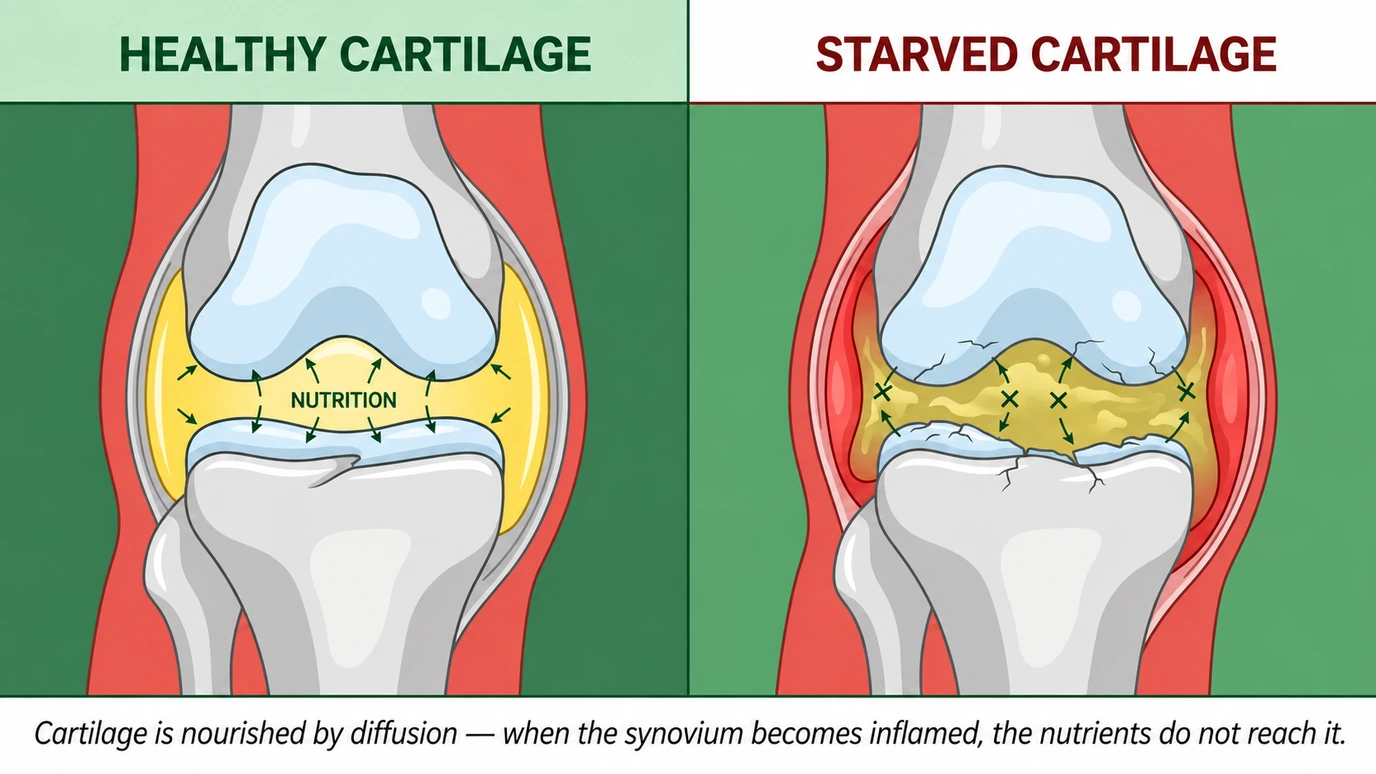
Cartilage doesn't have its own blood supply. It gets its nutrients through a process called diffusion — the surrounding joint fluid (synovial fluid) delivers oxygen and nutrients into the cartilage when the joint moves. When the joint moves well and the synovial environment is healthy, the cartilage is nourished. When it's not, the cartilage is effectively starved.
What drives this starvation? Three things, each feeding the others:
Chronic low-grade inflammation — the joint lining swells, the synovial fluid thickens, and fewer nutrients reach the cartilage.
Reduced circulation — blood flow to the tissues around the knee decreases, particularly in people who are less active (which, of course, includes everyone whose knee hurts too much to move properly).
Muscle weakness and stiffness — the muscles that stabilise and support the knee weaken from disuse, increasing the mechanical stress on the cartilage that remains.
This is why painkillers don't stop the progression. They silence the alarm, but they don't address the inflammation, the poor circulation, or the stiffness that are starving the cartilage. The decline continues behind the pharmaceutical curtain.
But here's the part that matters most: at Stage 2, this cycle can still be disrupted. The cartilage hasn't thinned to the point of no return. The inflammation can be reduced. The circulation can be improved. The muscles can be supported. The diffusion of nutrients into the cartilage can be restored.
The question is: how?
What David Found — Three Weeks Before His Referral Appointment
I'm going to be honest about something. I didn't find this — David did. Or rather, Pat did, on her iPad at half past ten at night, after David had spent another evening shifting in his armchair trying to find a position that didn't make his knee throb.
She rang me the next morning. "Have you heard of these knee wraps that do heat and vibration together? David won't look at it because he says it'll be rubbish, but I want to know what you think."
What she'd found was a device called RecovrKnee.
I'll admit, I was sceptical. I've reviewed enough "miracle cures" to have a well-developed allergy to them. But when I looked into what this device actually does — not the marketing claims, but the mechanism — I realised it was targeting exactly the three problems I'd just spent months researching.
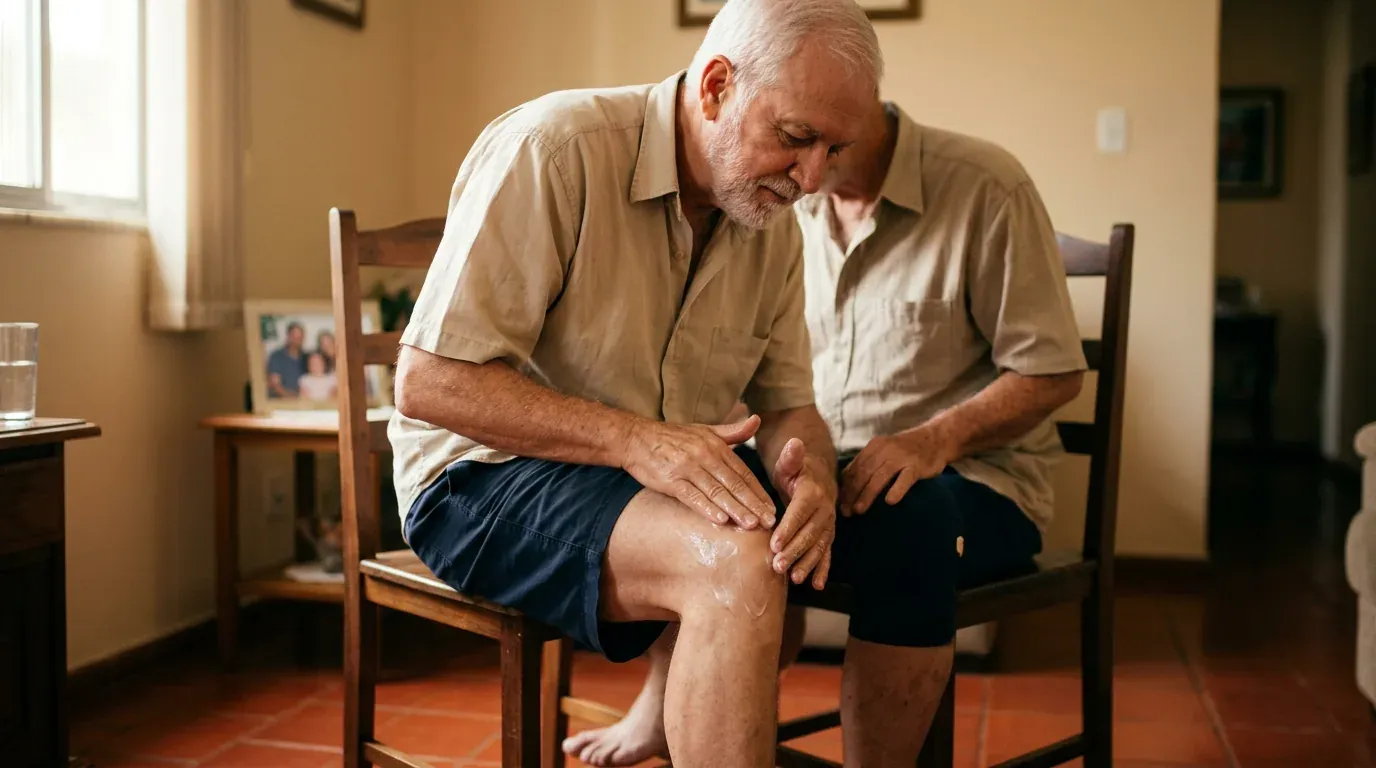
RecovrKnee is a rechargeable knee wrap that delivers three therapies simultaneously: targeted heat, therapeutic vibration, and graduated compression. It charges via USB, fits most knee sizes, and has an auto shut-off so you can use it in your armchair without worrying about falling asleep with it on.
That sounds simple. But each of those three elements maps directly onto the deterioration cycle I described above.
| Therapy | What It Targets | Why It Matters at Stage 2 |
|---|---|---|
| Targeted Heat | Chronic inflammation and synovial stiffness | Heat therapy is one of the most well-evidenced approaches for OA joint pain. It increases blood flow to the joint capsule, reduces the viscosity of synovial fluid, and helps calm the low-grade inflammatory response that blocks nutrient diffusion to cartilage. Unlike oral anti-inflammatories, it works locally — no stomach lining at risk. |
| Therapeutic Vibration | Poor circulation and muscle inactivity | A 2024 umbrella review of systematic reviews published in PeerJ found vibration therapy to be a "promising adjunct" for knee OA, particularly for physical function and pain. Vibration stimulates blood flow to the periarticular tissues, mimicking some of the circulatory benefits of movement — crucial for people whose pain prevents them from being as active as they need to be. |
| Graduated Compression | Joint instability and swelling | Compression supports the weakened muscles around the knee, reduces swelling by assisting venous return, and provides proprioceptive feedback — the joint "knows where it is" — which improves confidence and stability during movement. It's the same principle behind medical compression stockings, applied to the knee. |
What struck me was the simplicity: no pills, no injections, no prescriptions. You wrap it on, press the button, and sit with it for 15 to 20 minutes. The heat and vibration work into the joint while the compression holds everything in place. You can use it watching the telly, reading the paper, having a cup of tea.
I told Pat to order one. I also told her not to tell David I'd recommended it, because he'd reject it purely on principle.
What Happened Over the Next Six Weeks
Pat put the wrap on David's knee the first evening, while he was watching the football. He grumbled. He said it felt "odd." Then he went quiet for fifteen minutes, which — if you know David — is unusual.
Days 1–3: David described a deep, penetrating warmth unlike anything he'd felt from a gel or patch. Within the first session, the stiffness in his knee eased enough for him to get out of his chair without pushing off. Not pain-free — but noticeably less rigid. He used it again the next morning before walking the dog. And the morning after that.
Week 1: The morning stiffness that had been lasting thirty minutes was down to about ten. Pat said he'd stopped gripping the banister on the stairs — he was still using it, but with one hand, not two. He came back from walking the dog and said, unprompted, "I went round the long way today." That was the route through the park he'd quietly abandoned four months earlier.

Week 3: The constant background ache — the one that David had lived with for so long he'd stopped mentioning it — was intermittent. Some days it barely registered. He was using the wrap twice a day: once in the morning and once in the evening. He'd stopped taking ibuprofen every day. Pat found a half-full blister pack on the kitchen windowsill that he'd simply forgotten about.
Week 6: David had his delayed referral appointment with the orthopaedic consultant. The consultant examined his knee, reviewed his X-rays, and said something that made Pat ring me immediately afterwards.
David is not cured. His cartilage hasn't magically regrown. But the cycle — the inflammation, the stiffness, the inactivity — has been disrupted. He is moving more, hurting less, and the progression has slowed. In the consultant's words: "Functionally, you're presenting better than I'd expect."
He's still at Stage 2. But he's no longer drifting towards Stage 3.
The People Who Waited
After David's experience, I went looking for other stories. I spoke to readers, family members, people in online arthritis support groups. And the pattern I found was consistent — but it came with a painful distinction.
The people who started using targeted heat-and-vibration therapy while they were still at Stage 2 — while their pain was bothersome but manageable, while they could still walk, still get up and down — almost universally reported meaningful improvement. Less stiffness. Better mobility. Less reliance on daily painkillers. Several had been able to postpone or avoid surgical referral entirely.
The people who waited until Stage 3 or beyond — until the night pain, the visible swelling, the loss of range — still found relief from the immediate discomfort. But none of them reported the functional recovery that the Stage 2 group described. The inflammation could be calmed, but the structural damage couldn't be reversed.

This is the cruelty of Stage 2. It doesn't feel urgent. The pain is real, but you can live with it. It doesn't seem like a deadline. But it is one.
The NHS orthopaedic queue moves slowly. The average wait for trauma and orthopaedic treatment is well beyond the 18-week target — only 54% of patients are seen within that window. While you wait, your knee doesn't wait with you. It continues to deteriorate. The muscles around it continue to weaken. The inflammation continues to block the nutrients your cartilage needs.
The waiting list is not a pause. It's a countdown.
How to Know Which Stage You're At
Occasional stiffness or clicking. Discomfort after long walks or gardening that settles with rest. No significant daily impact.
You have time — but not unlimited time. This is the moment to act before symptoms establish themselves.
Daily stiffness, especially mornings. Pain on stairs, getting up from chairs, after sitting in the car. You've quietly reduced your activity. Painkillers help but don't solve it. You can still function, but your knee dictates what you do and don't do.
This is your window. You are still within the point where the cycle can be disrupted. Right now, today.
Night pain, visible swelling, significant loss of movement, reliance on strong painkillers. Daily life is substantially affected.
The window has narrowed significantly. Relief is still possible, but full functional recovery is unlikely without medical intervention.
The majority of people reading this are at Stage 2. If that's you — what you do in the next few weeks matters more than you think.
What David's Consultant Said When I Asked About It
I rang the consultant's secretary and asked whether he'd be willing to comment, off the record, on the use of combined heat, vibration, and compression therapy for Stage 2 knee osteoarthritis. He rang back the following day.
He was careful — consultants always are — but what he said was telling.
That last sentence has stayed with me. "I'd far rather see patients doing something proactive at Stage 2."
The Last Thing I'll Say
I'm a health journalist, not a doctor. I can't tell you that RecovrKnee will work for you the way it worked for David. Bodies are different. Knees are different. Osteoarthritis is complex.
What I can tell you is this: if you're at Stage 2, you have a window. It's not closing tomorrow, but it is closing. Every week that passes with unaddressed inflammation, poor circulation, and weakening muscles is a week your knee moves a little further along that progression. Painkillers don't stop it. Waiting for the NHS doesn't stop it. Only addressing the underlying cycle — the inflammation, the circulation, the support — has any chance of slowing it down.

David used to plan his day around his knee. Now his knee fits around his day. He's not twenty again. He still has osteoarthritis. But he has his walk in the park, his vegetable patch, and — as Pat puts it — "he can get out of a chair like a normal person again."
RecovrKnee comes with a 30-day money-back guarantee. That's a month to find out whether it makes a difference. If it doesn't, you send it back. If it does, you've disrupted the cycle at the point where disruption still matters.
But consider this: if you spend the next month doing nothing — taking the same painkillers, sitting out another month on the waiting list — you won't be at the same stage you are today. You'll be one month further along.
David nearly missed his window. He got lucky. Not everyone does.
RecovrKnee — 3-in-1 Heat, Vibration & Compression Therapy
Targeted relief for knee osteoarthritis · Rechargeable USB · Auto shut-off · Universal fit
✓ 30-Day Money-Back Guarantee · ✓ Fast UK Shipping · ✓ 24/7 Customer Support
Check Availability & Pricingⓘ Limited stock. Delivery typically within 24–72 hours.